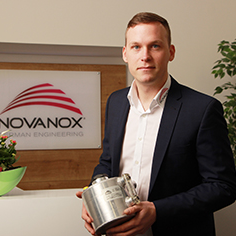
AdBlue Tanks for Machinery, Systems, and Vehicle Technology
AdBlue tanks are used for storing and dispensing AdBlue in machinery, systems, and vehicle technology. AdBlue is a mixture of urea and distilled water. The mixture is injected into the exhaust stream and helps to reduce nitrogen emissions.
In addition to legal guidelines, AdBlue tanks must meet a variety of requirements. In daily use, AdBlue tanks are constantly exposed to mechanical stresses, vibrations, and temperature fluctuations. The strength requirements are further increased by complex geometries designed for maximum filling volume.
Customised AdBlue Tanks
With our many years of experience as a system supplier and component supplier in tank technology, we develop and produce customised AdBlue tanks for manufacturers of machinery, systems, and vehicle technology. From simple to complex geometries, our modern manufacturing capabilities enable us to realise AdBlue tanks for every installation situation. NovaNox® AdBlue tanks, whether single-walled or double-walled, are made from stainless steel (stainless steel AdBlue tanks).
NovaNox® AdBlue tanks are therefore always individually tailored to the installation possibilities. This ensures that even particularly confined spaces are utilised effectively. At the same time, the filling volume of the AdBlue tank is maximised.
What is AdBlue?
AdBlue is an auxiliary operating fluid used in trucks with SCR technology and diesel engines. It consists of urea and demineralised water. Urea is a synthetic nitrogen compound. Exhaust gases are first passed through the oxidation catalytic converter. Subsequently, they "flow" through the diesel particulate filter. AdBlue is then added, initiating a thermal reaction. Through this reaction, the AdBlue decomposes and is converted into ammonia. The final reaction then takes place in the SCR catalytic converter, where ammonia reacts with nitrogen oxides, converting both substances into nitrogen and water. Typically, the AdBlue tank or the filler flap for refilling is located next to the filler neck for petrol or diesel. 3-5% of the AdBlue solution is required relative to the diesel consumption in litres. In addition to significantly reduced pollutant emissions for the environment, another advantage of AdBlue is that fuel consumption in diesel machines with SCR technology decreases by up to 5%.
It is important that you do not add antifreeze or similar substances to the AdBlue tank. If an incorrect liquid has been filled into the AdBlue tank, the machine or vehicle should not be started. Instead, notify the workshop immediately, as it can have similar consequences to incorrect fuel refilling.
Even though AdBlue technology stands for significantly reduced pollutant emissions, there are two minor disadvantages. Firstly, AdBlue must be refilled regularly. Regularly in this case means after a distance of approximately 20,000 kilometres driven. This figure varies depending on driving style. However, AdBlue can now be easily refilled at many petrol stations, and the tanks are generally designed such that refilling is only required during manufacturer inspections. Another disadvantage is that AdBlue technology can currently only be used in vehicles powered by diesel.